


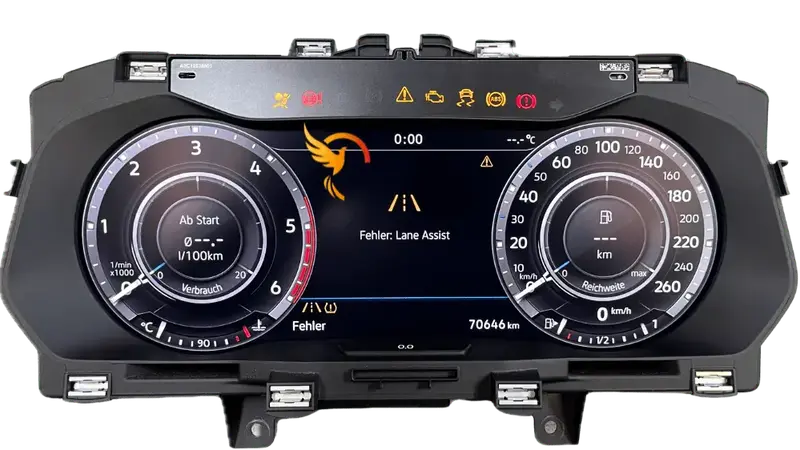
Common electronic problems and causes in instrument clusters
The instrument cluster is the heart of the dashboard. It displays speed, engine speed, fuel level, and more. However, electronic faults can impair this vital component – even leading to complete failure. In the case of the Revonik GmbH In Kerpen/Sindorf we specialize in the repair of combination instruments and know the most common problems and their causes.
In this article, we examine the most common defects and explain why they occur. We also show how you can save up to 80% of the cost of a new purchase by repairing the product.
Typical electronic faults in instrument clusters
1. Pixel defects
Symptom: Unreadable or flickering displays, especially in older models (e.g. Audi, BMW, Volvo).
Cause: Defective solder joints or wear and tear on the display.
2. Analog display failure
Symptom: The speedometer, tachometer, or fuel gauge work sporadically or not at all.
Cause: Wear and tear of the drive motors or faulty electrical impulses.
3. Complete failure of the instrument cluster
Symptom: The entire instrument cluster remains dark; all displays fail.
Cause: Short circuit in the power supply, defective control board or faulty software.
4. Malfunctions of indicator and warning lights
Symptom: Warning lights (e.g., airbag, engine, ABS) illuminate without any apparent reason, flash sporadically, or warning lights glow dimly.
Cause: Faults in the electronics, loose connections or transmission problems between control units.
5. Failure of the warning buzzer
Symptom: No warning tone for open doors, empty tank, or unfastened seatbelt.
Cause: Electronic problems or a faulty warning buzzer in the instrument cluster.
6. Communication problems
Symptom: Error messages such as "No connection to the instrument cluster" in the diagnostics.
Cause: Defective processors disrupt the CAN BUS connection.
The most important symptoms of defective instrument clusters
Faulty instrument clusters often manifest themselves in specific malfunctions. Here are the most common symptoms:
Warning signs in instrument clusters:
Sporadic or complete failure of the displays (speedometer, tachometer, fuel gauge or temperature gauge).
Indicator lights flash or glow irregularly.
The odometer or trip odometer is not working correctly.
The instrument cluster lighting fails partially or completely.
No warning tone for empty tank or unfastened seatbelt.
The turn signal indicator or hazard warning lights are not working.
Vehicle does not start (e.g., immobilizer is not deactivated).
Model-specific problems:
Ford C-Max / Ford Focus II: Faulty instrument clusters can prevent the vehicle from starting. Various CAN bus malfunctions are stored in the fault memory.
Volvo S60: Instrument cluster failures are often associated with error code D004.
BMW: Pixel problems are particularly common in older 5 and 7 series models.
Main causes of electronic defects
1. Vibrations in the vehicle
Vibrations during driving can lead to loose connections over time. These impair the function of the instrument cluster or cause short circuits.
2. Aging of electronics
Solder joints on circuit boards lose their conductivity over time.
Plug connections corrode or are affected by moisture.
3. Extreme temperatures
Heat can damage electronics, while cold can lead to brittleness. Temperature fluctuations, which create material stresses, are particularly problematic.
4. Moisture and water damage
Moisture can penetrate the electronics, e.g. through:
Leaky windshields or seals.
Meltwater, condensation in winter.
5. Faulty control unit communication
Problems in the CAN bus system disrupt the data exchange between the instrument cluster and other components.
Why a repair makes sense
A faulty instrument cluster doesn't automatically mean you have to buy a new one. In most cases, repairs are not only possible, but also significantly cheaper.
Advantages of repair:
Cost savings: Up to 80% cheaper as a new purchase.
Sustainability: Reduction of electronic waste.
Time saving: Fast troubleshooting without long waiting times for spare parts.
Installation: No further coding is required after installation; all data is retained.
This is how repairs work at Revonik GmbH
At the Revonik GmbH In Kerpen/Sindorf we have developed a proven repair process:
Repair process in detail:
Fault diagnosis: Using state-of-the-art technology, we analyze the defect precisely.
Replacement of defective components: Solder joints, components and wires are repaired or replaced.
Final exam: Every repaired instrument cluster undergoes comprehensive testing.
When is a repair not possible?
In rare cases, a replacement circuit board is required:
Total loss of the circuit board due to water damage.
Irreparable breaks in the conductor tracks.
Outdated technology that is no longer compatible.
In these cases, we offer replacement circuit boards that we can pre-program for your vehicle. (This includes data transfer, mileage, immobilizer settings, etc.)
How much does a repair cost?
The costs depend on the vehicle type and the nature of the defect.
Examples of typical repairs at Revonik GmbH:
Pixelprobleme: from 129 €
Analog display failure: from 119 €
Complete failure: from 149 €
A notice: For precise cost estimates, use our configurator to find suitable repair options by make and model. (If your part is not listed in the configurator, simply call us at 022739916424.)
Final thought: Repair instead of buying new
A faulty instrument cluster doesn't have to be an expensive problem. Repairs are often the smart, sustainable, and cost-effective solution.
Your advantages at Revonik GmbH:
Transparent pricing.
Fast processing.
Warranty on the repair carried out by us.
Contact us now via our inquiry form or use our configurator to have your instrument cluster (speedometer) repaired.
Common repairs of instrument clusters:
Audi
Audi A4: Instrument cluster failure with sporadically flashing warning lights.
Audi A5: Pixel defects in the display that make important information such as the mileage unreadable.
Audi Q7: Complete failure of the instrument cluster due to moisture damage.
Audi TT: Warning signs in the instrument cluster, e.g. flashing airbag light.
BMW
BMW 5er: Pixel defects in the display, especially common in older models.
BMW X3: Instrument cluster failure with flickering lights.
BMW X7: Malfunctions of the warning lights, e.g. airbag or ABS lights.
Mercedes-Benz
E-Class: Complete failure of the instrument cluster, including speedometer and tachometer.
GLE: The warning buzzer and flashing indicator light are not working.
A-Class: Indicator lights gleam sporadically.
Volkswagen (VW)
VW Tiguan: Instrument cluster failure with sporadic dim lighting.
VW Golf: Warning signs in the instrument cluster, e.g., fuel warning light not working.
VW Passat: Pixel defects in the display, especially in older models.
Ford
Ford Focus: The instrument cluster shows no connection to the control unit.
Ford Kuga: Total failure of the instrument cluster including the odometer.
Ford S-Max: Hazard warning lights activate sporadically without input.
Opel
Opel Insignia: Pixel defects and unreadable mileage readings.
Opel Astra: Warning lights for airbag and ABS are flashing for no reason.
Opel Zafira: Instrument cluster failure with sporadic flickering of the lighting.
Volvo
Volvo XC40: The instrument cluster displays no readings, and the vehicle does not start.
Volvo S60: Pixel defects and inaccurate RPM display.
Hyundai
Hyundai Tucson: Instrument cluster failure with inaccurate fuel gauges.
Hyundai i30: Warning buzzer for door and seatbelt warning fails.
Fiat
Duchy: The lights glowed dimly.
500: Speedometer not working.
Solutions at Revonik GmbH
Fix pixel defects: We repair faulty displays quickly and cost-effectively.
Eliminate warning signs: Electronic faults are precisely diagnosed and corrected.
Repairing instrument cluster failures: Complete failures or sporadic errors are rectified by replacing defective components.
Use our Configurator to find your vehicle model and receive a customized repair quote!

