


Vehicle Identification Number (VIN): Examples & Relevance for Control Unit Repair
The VIN – the Vehicle Identification Number – is crucial for the precise identification of vehicles. It is required to uniquely assign technical details such as year of manufacture, model, and equipment – especially when repairing control units. Whether it's the ABS control unit, engine control unit, or instrument cluster: only with the correct VIN is a precise repair possible. This overview shows typical vehicle models, including example VINs and common repair needs. It serves as a practical guide for workshops and vehicle owners who want to read fault codes and have them repaired accordingly.
Now for the enquiry: https://revonik.de/anfrage
Why the VIN is important for vehicle owners
The Vehicle Identification Number, or VIN, is the key to uniquely identifying every motor vehicle. It consists of 17 characters – a combination of numbers and letters – and is comparable to a fingerprint: Every vehicle has a unique VIN that neither changes nor is ever assigned to the same vehicle. This number is particularly important when it comes to repairs, buying a used car, or theft protection.
Many vehicle owners first encounter the VIN when the engine warning light illuminates or an error message appears in the engine control unit. In such cases, it is crucial to be able to quickly and accurately identify the correct control unit. This is precisely where the VIN plays a central role. It contains information about the vehicle type, model series, model year, and place of manufacture – all details that are indispensable when selecting or repairing a control unit.
At Revonik, the VIN is an essential part of every repair request. Our diagnostic technicians need it to correctly identify the defective engine control unit and perform a precise repair. Problems with the stored VIN are particularly common with BMW and VAG models where used control units or speedometers have been installed. We offer specialized solutions to professionally transfer this number to the original vehicle – a service not offered by many workshops.
Anyone considering repairing their control unit should always have the VIN readily available. It serves not only as proof of vehicle identity but also as the basis for a quick and error-free repair.
What is a FIN and how is it structured?
The Vehicle Identification Number (VIN) has been the globally recognized standard for uniquely identifying motor vehicles since 1981. It replaced the older chassis number, which was primarily used for vehicles with a separate chassis. While the term "chassis number" is still often used in everyday language, the VIN is what is actually meant.
The VIN consists of exactly 17 characters, a standardized combination of letters and numbers. Each part of this structure provides valuable information about the vehicle and is readable worldwide. The first three characters form the World Manufacturer Identifier (WMI). This part reveals not only the manufacturer but also the country where the vehicle was produced.
Characters four through nine contain information about the model series, body style, drive type, and other vehicle-specific characteristics. This information is particularly relevant for workshops when it comes to assigning a suitable engine control unit (ECU) or repairing an existing one. Precise knowledge of these VIN segments is especially helpful when troubleshooting and selecting the correct ECU.
The tenth character indicates the model year, which is not the same as the year of manufacture. The eleventh character represents the plant or production site of the vehicle. The last six characters of the VIN form the serial number – the unique vehicle number within the production run.
Unlike the old chassis number, the VIN is now tamper-proof, stamped directly into the vehicle, and also documented in the vehicle registration documents. This makes it an indispensable tool for anyone working with precise repairs – for example, in the field of control unit diagnostics and repair. Revonik uses the VIN to quickly and reliably identify the correct control unit and to carry out repairs precisely according to vehicle type.
Where can I find the VIN on my vehicle?
The Vehicle Identification Number (VIN) is documented in several places – both in official documents and directly on the vehicle itself. Anyone troubleshooting a faulty engine control unit (ECU) or an illuminated engine warning light should know where to find the VIN. This is because, when repairing control units – for example, at Revonik – the VIN is essential for precisely identifying the vehicle and the correct electronics.
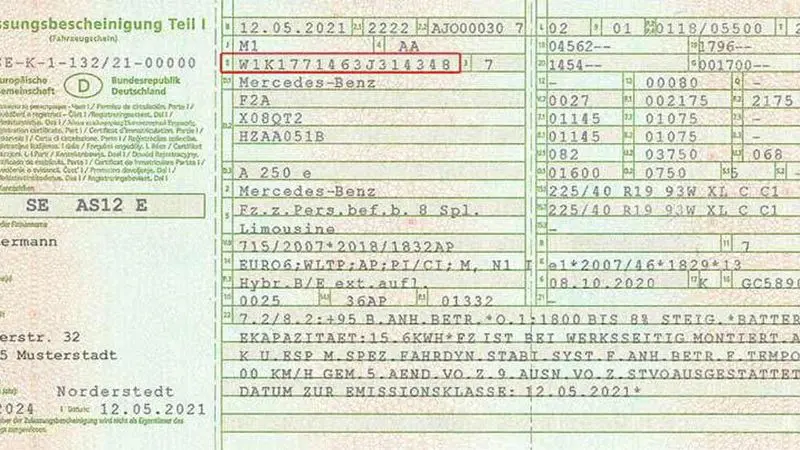
The easiest way to find the VIN is in the Vehicle registration certificate Part I (formerly: vehicle registration document) as well as in Part II(formerly: vehicle registration document). It is located in field "E" in Part I and also in the upper section of Part II. These documents should always be readily available when sending in a control unit for repair or submitting an inquiry via our Repair configurator place.
In addition, the VIN is also permanently affixed to several locations on the vehicle – usually stamped directly into the metal or attached to a type plate. Typical locations are:
- At the B-pillar on the driver's side (visible when opening the door)
- Under the windshield on the driver's side (visible from the outside)
- In the engine compartmente.g. on the upper frame or on the lock carrier
- In the trunk, often in the spare wheel well
- In the footwell or on the floor panel under a flap or carpet cover
These multiple placements serve as theft protection and make the VIN tamper-proof. On older vehicles, it was often only mounted as a sticker – today it is permanently and securely embossed. For anyone who wants to have their control unit tested or repaired at Revonik, the VIN is the basis for correct identification. If you have any questions about the correct location, our [contact person/office/etc.] will be happy to help. Support gladly continue.
Decoding the VIN: Here's how, step by step
The VIN is more than just a serial number – it contains detailed information about each vehicle. Anyone with a defective engine control unit or who reads a fault code can decode the VIN to draw important conclusions about the year of manufacture, model variant, and engine type. This information is crucial when a control unit needs to be tested or repaired at Revonik.
The 17-digit code is divided into several sections, which are structured in a standardized way:
- Characters 1 to 3 – World Manufacturer Identifier (WMI): Indicates the country of origin and the manufacturer of the vehicle. Example: "WVW" stands for VW from Wolfsburg.
- Characters 4 to 9 – Vehicle type & model series: These positions describe the model, body style, engine type, and safety features.
- Character 10 – Model year: A letter or number indicates the year in which the model was built.
- Sign 11 – Place of production: Indicates the factory where the vehicle was produced.
- Characters 12 to 17 – Serial number: A sequential number that uniquely identifies the vehicle.
To decode the VIN, you can go to free online decoders You can use tools that list all available vehicle information based on the VIN. Many manufacturers also offer their own VIN decoders for their models.
Especially with control units, knowing the exact vehicle configuration is essential. At Revonik, we use the decoded VIN to identify suitable replacement parts, check software versions, and tailor the repair precisely to your vehicle. If the VIN is not correctly registered—for example, with used control units—we can rewrite it to match the vehicle. This saves time and money and ensures that your control unit functions reliably again after the repair.
Start your inquiry now via Revonik.
Have your vehicle registration checked: Security through transparency
Checking the VIN is a simple yet effective step to gain more transparency about a vehicle – especially when troubleshooting or sending in an engine control unit for repair. This is because the VIN provides not only technical information but also important data about the vehicle's history.
A FIN query can clarify, among other things, the following points:
- Previous accidents or repairs
- Service history and maintenance intervals
- Open recalls by the manufacturer
- Theft status or shutdown
This information is crucial, especially when buying a used car – but also relevant for ECU repairs. An ECU can only be reliably repaired and correctly identified if it's clear in which vehicle it was originally installed. At Revonik, VIN verification is therefore an integral part of every diagnostic process and a key factor for correct identification and calibration.
Numerous online portals are available for private individuals and workshops where the VIN can be looked up. Well-known providers include: carVertical, AutoDNA, Cebia or mobile.de FIN-Check They offer varying levels of service. While simple queries are often free, detailed reports – including accident data and service records – can cost between 10 and 20 euros. The investment is worthwhile if there are uncertainties or if the vehicle was imported from abroad.
When ordering ECU repair through Revonik, we recommend having your VIN ready from the start. This allows us to immediately check whether the unit is compatible with your vehicle's equipment or if a re-registration is necessary. You can find more information about the process in [link/section]. Repair configurator or directly through our Inquiry form.
The VIN in control unit repairs – what makes Revonik different
The vehicle identification number (VIN) plays a crucial role in the repair of control units – especially when used control units, speedometers, or instrument clusters have been installed. A common problem arises when the VIN stored in the control unit does not match the vehicle's VIN. This leads to error messages, starting problems, or a permanently illuminated engine warning light.
This is precisely where Revonik comes in with a specialized service: We offer professional VIN re-registration to the correct vehicle. These issues occur regularly, especially with BMW models (e.g., E90, E60, E65) and VAG vehicles (Audi, VW, Seat, Skoda) – and are often ignored by many workshops. Revonik has the technical expertise, the appropriate software, and the necessary experience to reliably resolve such challenges.
What does this mean specifically for workshops and private individuals? If, for example, a used engine control unit (ECU) has been installed, Revonik can remove the old VIN from the unit and correctly enter the original VIN of the vehicle. This prevents diagnostic conflicts, ensures the full functionality of the ECU, and saves you the expense of buying a new, costly part.
Another advantage: The repair is precisely tailored to the vehicle model. Faulty communication with other control units, problems with vehicle coding, or limitations during vehicle inspections (MOT/emissions test) can thus be specifically avoided. For workshops, this means a smooth repair process – for end customers, greater safety and a fully functional vehicle.
Conclusion & Checklist: What you should always know about the FIN
The Vehicle Identification Number (VIN) is a key element for every vehicle owner – whether private individual or workshop. It not only serves to uniquely identify a vehicle, but is also an indispensable tool when it comes to repairing control units. Especially in cases of malfunctions in the engine control unit or when the engine warning light is illuminated, the VIN can help to resolve the problem more quickly and accurately.
The VIN reveals details about the manufacturer, model series, year of manufacture, and equipment, making it essential for the precise identification of control units. At Revonik, we use this information to tailor repairs to each individual vehicle – including VIN re-registration for used control units. This helps you avoid malfunctions and saves you the expense of purchasing new parts.
Checklist for vehicle owners: Find the VIN – check it – understand it
- Where can I find the VIN?
→ In the vehicle registration certificate Part I & II and several times on the vehicle (e.g. windshield, B-pillar, engine compartment) - How do I decode them?
→ The 17-digit VIN contains, among other things, information about the manufacturer, model, place of production and year of manufacture. - Why is the FIN so important?
→ When repairing control units, it ensures precise vehicle assignment. - Can I have the VIN checked?
→ Yes, via various online portals – also for accident history, recalls and theft protection. - What makes Revonik different?
→ Specializing in VIN re-registrations for BMW & VAG vehicles, fast repairs with precise assignment
Do you want to have a defective control unit checked or repaired?
Then start your request now via the Repair configurator or directly create an Contact requestWe will take care of your request – quickly, reliably and with expertise.
Recent repairs:
- Audi A1, 2003–2008, WAUZZZ8X13A123456, ABS control unit repair
- BMW 3 Series (E90), 2005–2012, WBAVC31070A456789 Engine control unit repair
- VW Golf 7, 2012–2020, WVWZZZAUZFP123456, Instrument cluster repair
- Opel Astra H, 2004–2010, W0L0AHL3551123456, ABS control unit repair
- Mercedes-Benz C-Class (W204), 2007–2014, WDD2040471A123456, Engine control unit repair
- Ford Focus Mk2, 2004–2011, WF0AXXWPDA4A12345, Instrument cluster repair
- Skoda Octavia II, 2004–2013, TMBJG61Z562123456, ABS control unit repair
- Renault Clio III, 2005–2014, VF1BR1V0545123456, Engine control unit repair
- Toyota Yaris, 2006–2011, VNKKJ98330A123456, Instrument cluster repair
- Peugeot 207, 2006–2012, VF3WA5FWC34512345, ABS control unit repair
- Hyundai i30, 2008–2012, TMAD351ABAJ123456, Engine control unit repair
- Mazda 3 (BK), 2003–2009, JMZBK143231123456, Instrument cluster repair
- Fiat Punto Evo, 2009–2012, ZFA19900012345678, ABS control unit repair
- Nissan Qashqai, 2007–2013, SJNFBAJ10U1234567, Engine control unit repair
- Dacia Sandero, 2008–2012, UU1BSDAAHAD123456, Instrument cluster repair
- Honda Civic 8, 2006–2011, SHHFK27608U123456, ABS control unit repair
- Seat Ibiza IV, 2008–2017, VSSZZZ6JZ9R123456, Engine control unit repair
- Citroen C3 II, 2009–2016, VF7SC8HXB9J123456, Instrument cluster repair
- Kia Ceed JD, 2012–2018, U5YHN812ABD123456, ABS control unit repair
- Mini Cooper R56, 2006–2014, WMWMF31010T123456, Engine control unit repair
- Subaru Impreza, 2008–2011, JF1GH6LD39G123456, Instrument cluster repair
- Volvo V50, 2004–2012, YV1MW754982123456, ABS control unit repair
- Suzuki Swift, 2005–2010, TSMNZC21S00123456, Engine control unit repair
- Alfa Romeo Giulietta, 2010–2020, ZAR94000007123456, Instrument cluster repair
- VW Passat B6, 2005–2010, WVWZZZ3CZ7E123456, ABS control unit repair
- Audi A4 B8, 2008–2015, WAUZZZ8K98A123456 Engine control unit repair
- Mercedes A-Klasse (W169), 2004–2012, WDD1690321J123456, Instrument cluster repair
- Opel Corsa D, 2006–2014, W0L0SDL0864123456, ABS control unit repair
- Ford Mondeo Mk4, 2007–2014, WF0GXXGBBG7A12345, Engine control unit repair
- Renault Megane III, 2008–2016, VF1BZ0K064J123456, Instrument cluster repair

